Skip to content Skip to sidebar Skip to footer

In 2025, the proliferation of sargassum reached unprecedented levels.

Florida is facing what Courrier International described as a “massive wave of sargassum”, while the Caribbean is struggling to cope with the invasion. In Mexico, Florida and Guadeloupe, the growing presence of these brown seaweeds has become a major environmental, economic and public health issue.

Sargassum is an invasive floating seaweed. It develops at the surface of the ocean, completing its entire life cycle at sea.

It can gather into vast floating mats covering more than 1,000 m² and reaching several metres in thickness. As the seaweed begins to decompose, a process that reaches its peak after approximately 48 hours, sargassum releases ammonia and hydrogen sulphide.

At this stage, it can become particularly harmful to people living in affected coastal areas. In Martinique, a study published on 24 June by an independent expert committee from the University Hospital, involving 154 patients over one year, reported neurological, digestive, respiratory, eye, ENT and psychological symptoms among exposed patients.

Repeated exposure to sargassum can have significant consequences for local communities, the environment and the economy of affected regions.

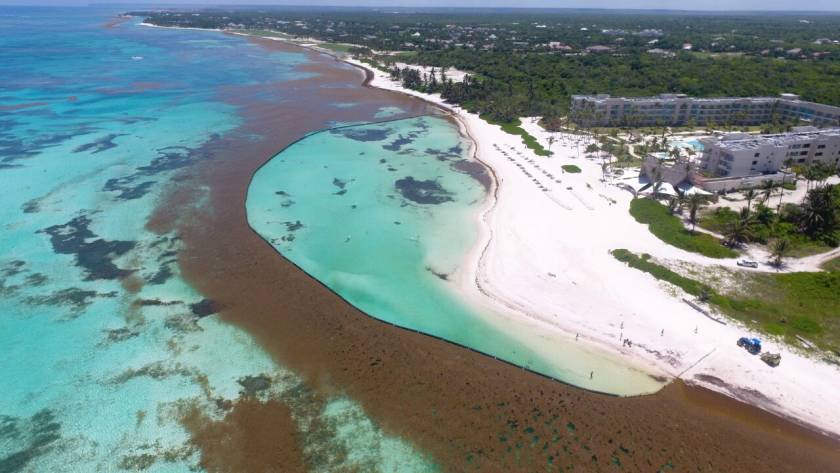
For more than ten years, we have been operating in Mexico with a system designed to protect beaches and coastal communities using offshore anti-sargassum barriers and nets.

Our vessels then collect the intercepted seaweed, while our teams provide the installation, monitoring and maintenance required to ensure the long-term effectiveness of the system.

Our approach provides a complete solution: interception at sea, collection and ongoing maintenance.

Anti-sargassum nets: the solution

En 2025, la prolifération des sargasses atteint un niveau inédit.  La Floride est cette année « face à une monstrueuse déferlante de sargasses » (Courrier International), les Antilles sont « dépassées par l’invasion des sargasses » (Reporterre), ce « Fléau des algues brunes au Mexique et en Floride » (24H) et en Guadeloupe selon Ouest-France, c’est « la difficile lutte ».  Ces algues brunes…

Read More

In 2025, the proliferation of sargassum reached unprecedented levels.

Florida is facing what Courrier International described as a “massive wave of sargassum”, while the Caribbean is struggling to cope with the invasion. In Mexico, Florida and Guadeloupe, the growing presence of these brown seaweeds has become a major environmental, economic and public health issue.

Sargassum is an invasive floating seaweed. It develops at the surface of the ocean, completing its entire life cycle at sea.

It can gather into vast floating mats covering more than 1,000 m² and reaching several metres in thickness. As the seaweed begins to decompose, a process that reaches its peak after approximately 48 hours, sargassum releases ammonia and hydrogen sulphide.

At this stage, it can become particularly harmful to people living in affected coastal areas. In Martinique, a study published on 24 June by an independent expert committee from the University Hospital, involving 154 patients over one year, reported neurological, digestive, respiratory, eye, ENT and psychological symptoms among exposed patients.

Repeated exposure to sargassum can have significant consequences for local communities, the environment and the economy of affected regions.

For more than ten years, we have been operating in Mexico with a system designed to protect beaches and coastal communities using offshore anti-sargassum barriers and nets.

Our vessels then collect the intercepted seaweed, while our teams provide the installation, monitoring and maintenance required to ensure the long-term effectiveness of the system.

Our approach provides a complete solution: interception at sea, collection and ongoing maintenance.